Companies may spend significant time and resources carefully drafting their online terms and conditions, but those terms will not do much good if consumers are not adequately put on notice of them. A recent Ninth Circuit decision provides another reminder that courts will look closely not only at what an online disclosure says but also at how and where it appears.
In Schlueter-Beckner v. SimpliSafe, Inc., consumers filed a putative class action relating to their purchases of SimpliSafe home security systems and monitoring services. SimpliSafe moved to compel arbitration based on its online Terms of Sale and Terms of Service. Consumers encountered those terms at two different points—when purchasing the hardware and when later enrolling in a trial of SimpliSafe’s alarm-monitoring services.
Conspicuous Notice Matters for Online Terms
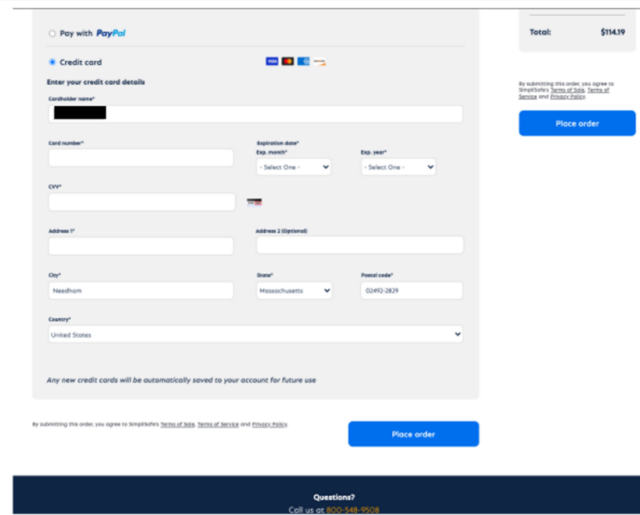
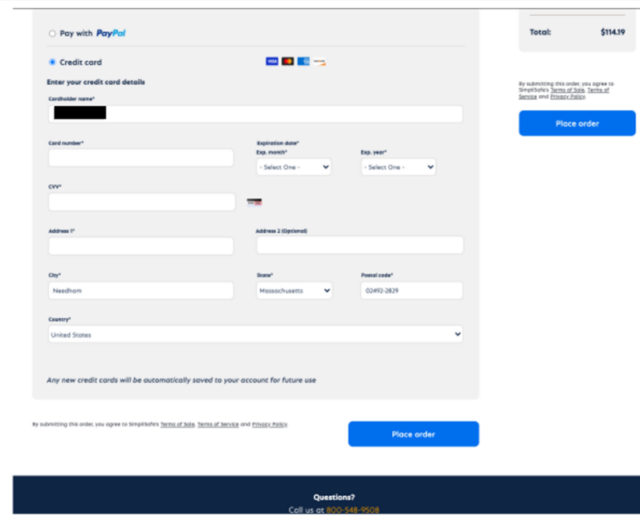
The Ninth Circuit concluded that SimpliSafe’s hardware checkout did not provide reasonably conspicuous notice of the terms. The court focused on the disclosure’s small font and gray text, its placement on the page, the substantial white space separating it from the “Place order” button, and other aspects of the checkout flow that directed consumers’ attention elsewhere. Importantly, the court did not evaluate the disclosure in isolation. Instead, it considered the design of the transaction as a whole.
The checkout screen at issue is shown below:
 Online Contract Formation Depends on Context
The monitoring enrollment flow produced a different—and instructive—result. The court found that the first two webforms did not establish an agreement because the context could lead consumers to believe the disclosure related only to communications. Critically, the court raised a disconnect between the disclosure, which stated that consumers agreed to the terms “[b]y submitting this number,” and the corresponding button, which simply said “Next.”
A later webform presented to one plaintiff, however, was stipulated to have formed an arbitration agreement. The court also held that the Terms of Service clearly and unmistakably delegated questions of arbitrability to the arbitrator through their incorporation of the AAA rules.
Online Terms Require Effective Presentation
Although Schlueter-Beckner is an unpublished and nonprecedential decision, it is another useful reminder that presentation matters. Courts evaluating online terms increasingly look at the entire user experience—including font size and color, placement, white space, competing visual elements, and the relationship between the disclosure and the button or other action that purportedly signifies assent.
Clear Consumer Assent Is the Takeaway
The practical takeaway is straightforward: companies should not assume that a hyperlink to terms somewhere near a checkout or enrollment button is enough. The terms should be conspicuous, the disclosure should clearly explain that the consumer is agreeing to those terms, and—perhaps most importantly—the disclosure should accurately and explicitly identify the action that constitutes assent.
Otherwise, a court could follow the Ninth Circuit’s reasoning and find that no contract was formed if the disclosure says that one action constitutes agreement while the interface asks the consumer to take another.
For more insights into advertising law, bookmark the All About Advertising Law blog and subscribe to our monthly newsletter. To learn more about Venable’s Advertising Law services, click here. And listen to the Ad Law Tool Kit Show—a podcast from Venable.